DAY 1: ARRIVAL DELHI
Arrive Delhi as per your flight timings.
Welcome at the Airport with flower garland and a bottle ow water.
Our company representative will assist you at the airport and
transfer you to your hotel.
Check in at 1400H.
Rest of the day at leisure.
Delhi is the capital city of India and one of its oldest cities,
with a rich historical and cultural heritage. It is located in the
northern part of the country and serves as the seat of all three
branches of the Government of India. The city is known for its
diverse population, historical monuments, vibrant markets, and a
mix of modern and traditional elements.
Overnight at hotel.
DAY 2: DELHI
Breakfast at Hotel.
Enjoy the sightseeing of New Delhi.
Visit the Raj Ghat on the banks of the river Yamuna, Mahatma
Gandhi's Memorial, where he was cremated following his
assassination in January 1948. The memorial lies in the midst of
landscaped gardens and made of a simple square platform of black
marble inscribed with his last words "Hey Ram". An eternal flame
burns 24 hours.
Drive past Red Fort (Exterior) the 17th century imposing fortress
built in red sandstone is surrounded by a huge 33m high boundary
wall. Inside are exquisite palaces and beautiful gardens.
Opposite the Red Fort lies Jama Masjid (Friday Mosque) made of red
sandstone and white marble, completed in 1656 at a cost of one
million Rupees has perfect proportions. Jama Masjid is India's
largest mosque where more than 20.000 people can kneel in prayer.
The interior of the prayer hall is divided into aisles by arches.
The walls and floors are of marble inlay panels.
Also, enjoy the Rickshaw Ride in the bazaars of Old Delhi.
Photo stop at India Gate Built of Bharatpur stone, commemorates
the 70,000 Indian soldiers who died in the 1st world war. 13516
names of British and Indian soldiers killed in the Afghan War of
1919 are engraved on the arch and foundations.
You will drive Past Rashtrapati Bhawan once the Viceroy's
residence is now the official residence of the President of
India.
Visit the Qutub Minar, built by Qutub-ud-din Aibek in 1199 and it
is one of the tallest minaret in India (73 meters height). It is
made from red sandstone & marbles.
Visit the Humayun's Tomb, built by his wife Haji Begum in the
16th. Century. An early example of Mughal architecture considered
the predecessor of the Taj Mahal.
Overnight at hotel.
DAY 3: DELHI / JAIPUR (250 km –5 h APPROX.)
Breakfast at the hotel.
Morning leave for Jaipur. Arrive Jaipur in the Afternoon.
Rajasthan's beautiful Pink City Jaipur, was the stronghold of a
clan of rulers whose three hill forts and series of palaces in the
city are important attractions. Known as the Pink City because of
the colour of the stone used exclusively in the walled city,
Jaipur's bazaars sell embroidered leather shoes, blue pottery, tie
and dye scarves and other exotic wares. Western Rajasthan itself
forms a convenient circuit, in the heart of the Thar desert which
has shaped its history, lifestyles and architecture.
Afternoon free for independent visits.
Overnight at hotel.
DAY 4: JAIPUR
Breakfast at hotel.
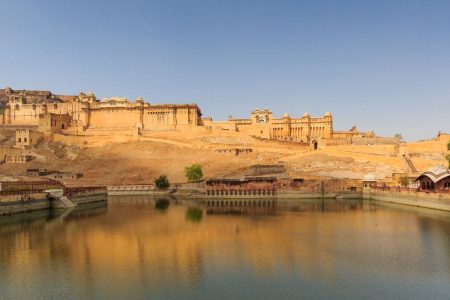
Morning visit the grand Amber fort - The old capital of the
Kachhwahas stands atop a range of craggy hills. The fort is
remarkable as much for the majestic grandeur of its surroundings
as for its sturdy battlements and beautiful palaces. It is a fine
blend of Hindu and Muslim architecture. The solemn dignity of it
red sandstone and white marble pavilions, when reflected in the
lake at the foot hill, is a sight to behold.
Visit Hawa Mahal (OUTSIDE) - built in 1799, by Maharaja Sawai
Pratap Singh, is the most recognizable monument of Jaipur. The 5
storied stunning semi-octagonal monument having 152 windows with
over hanging latticed balconies is a fine piece of Rajput
architecture. Originally designed for the royal ladies to watch
and enjoy the processions and other activities, on the street
below.
City Palace- situated in the heart of the old City, it occupies
about one seventh of the old city area. The palace is a blend of
Rajput and Mughal architecture, it houses a Seven storeyed Chandra
Mahal in the centre, which affords a fine view of the gardens and
the city. Diwan-E-Am (Hall of public audience) has intricate
decorations and collection of manuscripts, Diwan-E-Khas (Hall of
private audience) has a marble pawed gallery Mubarak Mahal has a
rich collection of costumes and textiles. There is a Clock Tower
near Mubarak Mahal. Sileh Khana has a collection of armory and
weapons.
Observatory - built in 18th century by Maharaja Sawai Jai Singh
II, the huge masonary instruments were used to study the movement
of constellations and stars in the sky. Enormous sun-dial still
provide accurate time, which are subject to daily corrections.
Continued with a Rickshaw ride in the old city of Jaipur.
Optional: Enjoy the movie in one of the oldest heritage movie
theater of Jaipur, Rajmandir.
Overnight at hotel.
DAY 5: JAIPUR –FATEHPUR SIKRI- AGRA (260 Kms / 5H30m)
Breakfast at Hotel.
Morning leave for Agra.
En route visit the Old city of Fatehpur Sikri.
The historical city was constructed by Mughal emperor Akbar
beginning in 1570 and served as the empire's capital from 1571
until 1585, when it was abandoned for reasons that remain unclear.
The surviving palace and mosque are a tourist attraction and a
UNESCO World Heritage Site.
The palace complex is lavishly ornamented and displays the riches
of Amer. Sheesh Mahal chamber of Mirrors. Diwan-e-Am or the Hall
of Public Audience is a beautifully proportioned hall open on
three sides and stands on two rows of ornamented pillars. Diwan
e-Khas or the Hall of Private Audience has delicate mosaic work in
glass. Sukh mandir is guarded by sandalwood doors inlaid with
ivory. Throughout the massive fort finely carved lattice windows,
exquisitely painted doorways, halls and finely sculptured pillars
crave for attention.
Overnight Stay at Hotel.
DAY 6: AGRA – JHANSI – KHAJURAHO (TRAIN & 169KMS / 4H)
Breakfast at hotel.
After breakfast visit the Taj Mahal. The Taj Mahal is a mausoleum
located in Agra, India, built by Mughal Emperor Shah Jahan in
memory of his favorite wife, Mumtaz Mahal. The Taj Mahal (also
"the Taj") is considered the finest example of Mughal
architecture, a style that combines elements from Persian,
Ottoman, Indian, and Islamic architectural styles. In 1983, the
Taj Mahal became a UNESCO World Heritage Site and was cited as
"the jewel of Muslim art in India and one of the universally
admired masterpieces of the world's heritage."
Post breakfast, departure transfer to Railway station for train to
Jhansi. Depart by TAJ EXPRESS (Train No.: 12280) at 1013 Hrs from
Agra.
Arrive Jhansi at 1400 Hrs and continue towards Khajuraho.
En route Visit Orchha.
On a seasonal island on the bank of the Betwa River, which has
been surrounded by a battlement wall, stands a huge palace-fort.
The fort consists of several connected buildings erected at
different times, the most noteworthy of which are the Raja Mahal
and the Jahangir Mahal.
The Ram Raja Temple is built on a square base and has an almost
entirely plain exterior, relieved by projecting windows and a line
of delicate domes along the summit. The Jahangir Mahal is built on
a rectangular base and is relieved by a circular tower at each
corner surmounted by a dome, while two lines of graceful balconies
supported on brackets mark the central storeys. The roof is
crowned by eight large fluted domes, with smaller domes between
them, connected by an ornamental balustrade.
The Jahangir Mahal is considered to be a singularly beautiful
specimen of Mughal architecture.[7] Chaturbhuj Temple is an old
temple from the 9th century.
Numerous cenotaphs or chhatris dot the vicinity of the fort and
the Betwa river. Elsewhere about the town there is an unusual
variety of temples and tombs, including the Chaturbhuj temple,
which is built on a vast platform of stone. The more unguarded and
neglected of these buildings are popular hangouts for tropical
bees, wasps, and other such excitable stingy creatures.
Continue towards Khajuraho.
Arrive Khajuraho late in the evening and transfer to hotel.
Overnight at hotel
DAY 7: KHAJURAHO
Post breakfast, visit the City & Khajuraho temples.
The Khajuraho Group of Monuments in Khajuraho , a town in the
Indian state of Madhya Pradesh, located in Chhatarpur District,
about 620 kilometres (385 mi) southeast of New Delhi, is one of
the most popular tourist destinations in India. Khajuraho has the
largest group of medieval Hindu and Jain temples, famous for their
erotic sculptures.
The name Khajuraho, ancient "Kharjuravāhaka", is derived from the
Sanskrit words kharjura = date palm and vāhaka = "one who
carries". In the 19th century, British engineer T.S. Burt arrived
in the area, followed by General Alexander Cunningham. Cunningham
put Khajuraho on the world map when he explored the site on behalf
of the Archaeological Survey of India and described what he found
in glowing terms. The Khajuraho Group of Monuments has been listed
as a UNESCO World Heritage Site, and is considered to be one of
the "seven wonders" of India.
Overnight at Hotel.
DAY 8: KHAJURAHO – VARANASI (FLIGHT)
Breakfast at hotel
Transfer to the airport for flight to Varanasi.
Arrive Varanasi & transfer to hotel and Check-in.
Evening, visit the Ghats with boat ride and see evening
Aarti.
Varanasi or Kashi is older than traditions. Varanasi presents a
unique combination of physical, metaphysical and supernatural
elements. According to the Hindu mythology, Varanasi liberates
soul from human body to the ultimate. It is the Ganga Ghats of
Varanasi that complement the concept of divinity. Ghats of Ganga
are perhaps the holiest spots of Varanasi. The Ganga Ghats at
Varanasi are full of pilgrims who flock to the place to take a dip
in the holy Ganges, which is believed to absolve one from all
sins.
There are number of temples on the bank of the Ganga river in
Varanasi. It is believed that people are cleansed physically,
mentally and spiritually at Ganga Ghats. It is at the Ganga Ghats
where we see life and death together. For thousands of years
people have been thronging these Ghats to offer their morning
prayers to the rising sun. There are more than 100 ghats along
side Ganga in Varanasi. Some of the prominent and popular Ghats at
Varanasi are the Dasaswamedh Ghat, Manikarnika Ghat, Harischandra
Ghat, Kabir Ghat and Assi Ghat.
Overnight at hotel
DAY 9: VARANASI
Breakfast at Hotel.
Morning visit the old city of Varanasi and the Bharat Mata
temple
Afterwards, visit Sarnath.
Sarnath, about 10 km from the holy city of Varanasi, is the place
where Buddha chose to deliver his first sermon. The celebrated
Mantra, 'Buddham Sharanam Gachhami', owes its origin to Sarnath.
On the day before his death Buddha included Sarnath along with
Lumbini, Bodh Gaya and Kushinagar as the four places he thought to
be sacred to his followers. It makes Sarnath one of the most
venerated Buddhist places. Besides Buddhism, Sarnath is also
connected with Jainism.
Time free to Relax.
Overnight at hotel
DAY 10: VARANASI – DELHI (FLIGHT)
Post breakfast, transfer to the airport for flight for Delhi.
Arrive Delhi and transfer to hotel.
Day at leisure.
Overnight at hotel.
DAY 11: DELHI - DEPARTURE
Post breakfast, Departure transfer to Airport for flight to onward
destination.
Connect with the Raag Voyages Team to craft your personalized
journey through India